Showing posts with label Architecture. Show all posts

New article in Engramma - La tradizione classica nella memoria occidentale

It was a pleasure and a privilege to receive the invitation to participate in a special issue of Engramma magazine on Toy Architecture.

I took the opportunity to finally tidy up the many ideas, concepts and content that I had developed over the last 12 years that I taught the Architectural Toys course at the Faculty of Architecture of the University of Porto.

Number 213 of June 2024, on top of that, has a group of authors of the highest quality, all around a theme that has gained space and robustness over the last few years until reaching a worthy epistemological status.

The article is written in Italian, but being online it is easily translatable into several languages.

Enjoy the reading!

https://www.engramma.it/eOS/index.php?id_articolo=5556


Architectural toys - first semester 2023-2024

This year I condensed even more the theoretical part of the course. It's true, over time and with so many repetitions, the result is to be increasingly synthetic and focus the course on the most important and pertinent things.

Sometimes fewer things in more time is more effective than a barrage of information that is of little use to students.

The result was more careful, more complex and more interesting work. The students themselves felt the difference and, once again, enjoyed the course.


Architectural toys at FAUP 2022/2023

One of the things I like about teaching is that even if I repeat the course every year, the results always change. Because students are always different, with different profiles, backgrounds and interests.

Despite that, this year I decided to change some things in the course, starting with the name. Now it is called "The ludic construction of architecture", paraphrasing the well-known book by Giorgio Grassi "The logical construction of architecture".

In addition, I reorganized the classes, synthesizing the subject and leaving more time to follow the work.

The result was many more candidates and works with a very high quality level.

Here some examples:


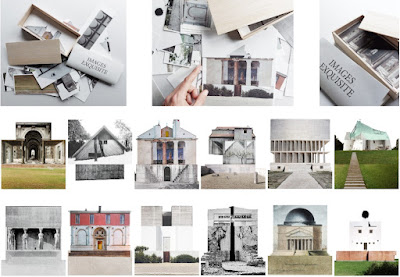
Pietro Alfano and Gábor Houchard work is inspired by the game Cadavre exquis (exquisite corpse), a collaborative drawing approach first used by surrealist artists to create bizarre and intuitive drawings. With a careful selection of images, the user can create several configurations that combine basements, facades and roofs.

Architectural toys at FAUP - 2020/2021

Another edition of my course at FAUP is over. This year I decided to change the course name for Architectural toys - A construção lúdica da Arquitectura (the ludic construction of architecture). The new name can cover more manifestations of what I call "educational project in architecture". I also reinforced and extended the field of contents because I found a deeper connection with arts, especially with the vanguards in the beginning of XX century. The new syllabus caused a little change in the student's works, now more abstract, that you can see below. Because the pandemic condition I canceled the cube exercise and we focused on the main practical or theoretical works. 

Ana Luis Fernandes Alago 


Ana Rita Santos Couto


Andrè Daniel Mendes Ferreira


Anna Lisa Senius 

Bruno Alves Guimarães


Carla Andreina Garcia Vera


Carolina da Silva Pereira


Chiara Cali'


Erika Nurmberger e Lucas Keller


Francisco Alberto Magalhães Peneda Ferreira


 Giulia Di Perna

Gustavo Kinjiro Murena


Maria Luis Coelho Nogueira


Mariana Costa Abreu


Mariana Rafaela Ramalho Araújo 


Mónica Cristina Jardim Dias


Parzival Pedro Schneider


Stéphanie Dijck Amorim da Silveira

Conversación ANIDAR

Aqui a minha conversa com Jorge Raedo no âmbito das "Concersaciones ANIDAR" da ARQA sobre Arquitectura y Nines.
 
Here my conversation with Jorge Raedo from ARQA's "Concersaciones ANIDAR" about Architecture and Childhood.


The first six books of Euclid's Elements by Oliver Byrne


Oliver Byrne (c. 1810-c. 1880) was an Irish author and civil engineer that wrote a considerable number of books on subjects including mathematics, geometry, and engineering. Among them, the most famous and really innovative is a very particular version of the first six books of Euclid's Elements that used coloured graphic explanations of each geometric principle.
Published in 1847 by William Pickering, the book has an extraordinary graphic and chromatic similarity with the Bauhaus design formatting. Indeed, in the whole book are used the primary colors red, yellow and blue (beside black of course). Flipping through its pages the reader hardly think that “The first six books of Euclid's Elements” by Byrne was written more than 70 years before the Bauhaus school opening.

The main aim of the book is to spread science, and the strategy is clearly graphical. In the introduction, the author say “The arts and science have become so extensive, that to facilitate their acquirement is of as much importance as to extend their boundaries. Illustration, if it does not shorten the time of study, will at least make it more agreeable”.

The interest of this book is not really the contents (even if the Euclid's Elements is one of the most important text about mathematics and geometry second only to the Bible in the number of editions and published since the first printing in 1482), but the real author’s afford in order to find the best way to show and to explain such complex and abstract concepts. 

Here the First Six Books of the Elements of Euclid on Scribd. Enjoy your reading.